Acoustics
6 texts
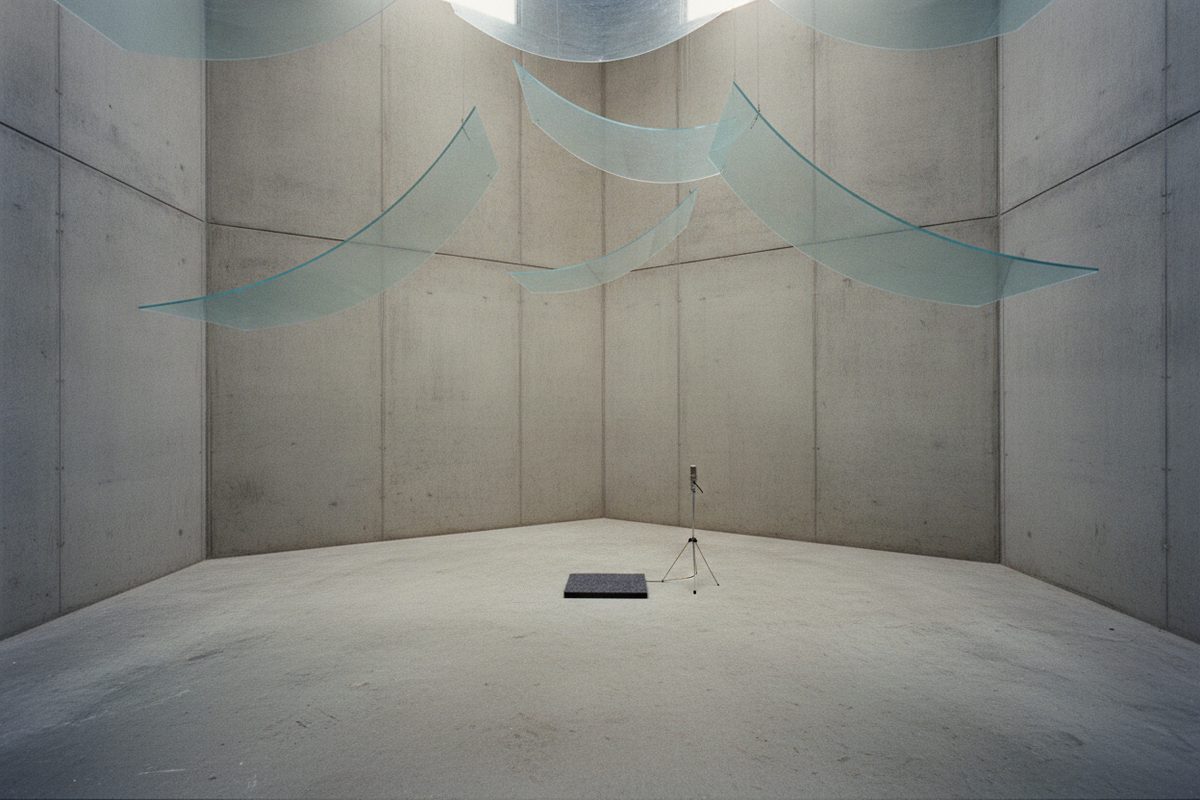
Archive editorial. This section is new writing added to the archive edition. It is not part of the original RANDOM ACOUSTICS website and does not speak for the label or its musicians.
The label documented in this archive is called RANDOM ACOUSTICS. Its pages do not say why that name was chosen, and the archive does not guess. The two words do, however, have a precise meaning in physics, and that meaning is the reason for this section.
In room acoustics, "random" describes sound that reaches a point from all directions with equal probability and with no fixed phase relation between the waves. Such a sound field is called diffuse. It is an idealisation, but a productive one: above a certain frequency most rooms come close enough to it that sound can be treated statistically, as energy, instead of as individual waves. Sabine's reverberation formula, the absorption coefficients printed on data sheets and the laboratory tests behind sound insulation ratings all rest on this assumption of random incidence.
The six articles explain these ideas and the measurements built on them, for students, musicians, engineers and anyone planning a room. They keep to established acoustics and the relevant ISO, IEC and ASTM standards, and they contain no product information.
- Random incidence: the diffuse field, the random-incidence absorption coefficient and the ISO 354 reverberation room.
- Measuring reverberation time: impulse responses, Schroeder integration, T20, T30 and EDT, ISO 3382-1 and 3382-2.
- Normal and random incidence: impedance tube against reverberation room, values above 1, αw, absorption classes, NRC and SAA.
- The room as part of the recording: reflections, clarity and microphone placement, with the places where the label's records were made.
- Speech in shared rooms: STI, speech privacy and the open-plan metrics of ISO 3382-3.
- Airborne sound insulation, enclosures and booths: mass law, Rw and DnT,w, flanking, leaks and speech level reduction.
For the music itself, start with the catalogue, the recording chronology or the venue index.
Contents