The room as part of the recording
Direct sound, early reflections, C80 and D50 in plain language, close and ambient microphones, and the rooms named on RANDOM ACOUSTICS records.
Acoustics
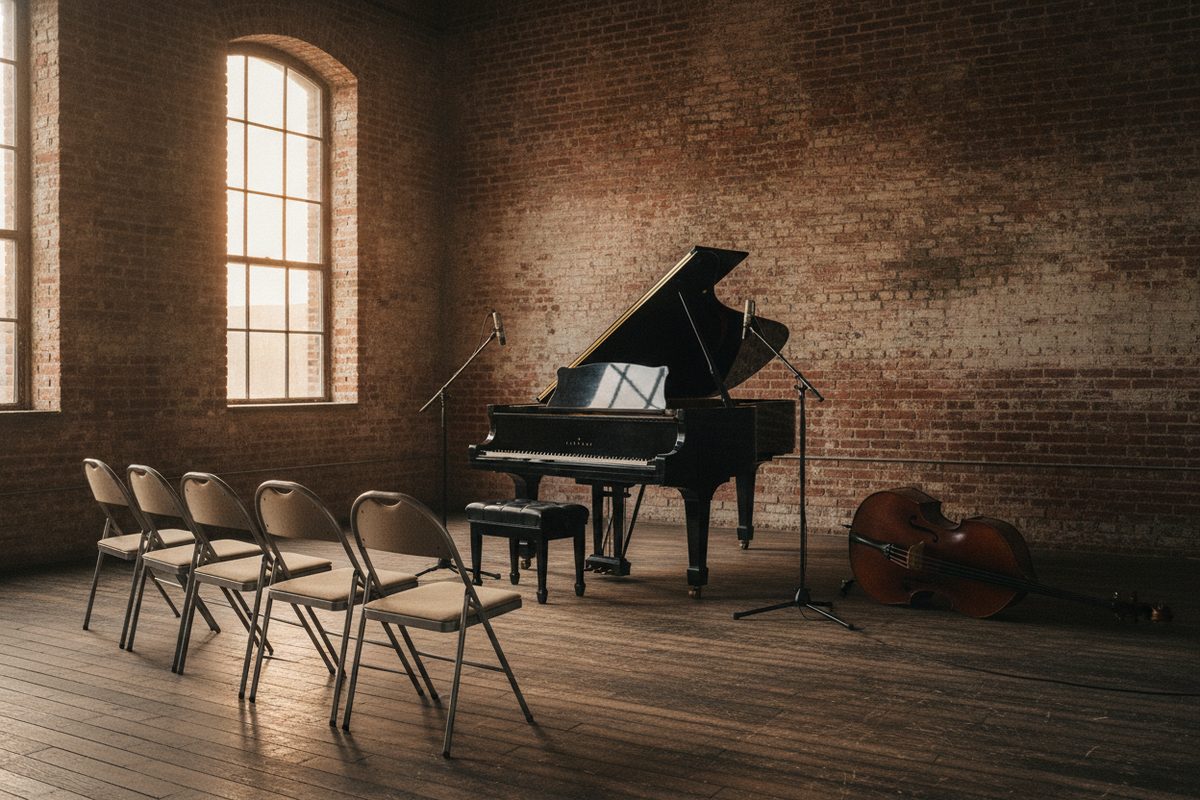
Every recording of an acoustic instrument is also a recording of a room. The microphone picks up the sound that travels straight from the instrument, then the same sound again from the floor, the nearest wall and the ceiling, and finally the dense, fading mixture of later reflections. How much of each it captures depends on the room and on where the microphone stands. In improvised music, where players respond to what they hear as it happens, the room also shapes the playing, because it decides what each musician hears of the others.
Three parts of what arrives
Acousticians usually divide the sound at a listening or microphone position into three parts.
Direct sound travels in a straight line from source to receiver. It arrives first and carries the clearest information about the instrument: its attack, its timbre in that direction and its position.
Early reflections arrive within roughly the first 50 to 80 milliseconds, from the surfaces nearest to source and receiver. The ear does not hear them as separate echoes. It fuses them with the direct sound, which still sets the perceived direction, an effect known as the precedence or Haas effect. Early reflections make sound louder and fuller, and those arriving from the sides make a source seem wider.
Late reverberation is everything after that: reflections so numerous and so mixed that they form a smooth decay. Statistical room acoustics, described in the article on random incidence, handles this part well. It gives a sense of the size of the space and joins successive notes together.
Where early ends and late begins is a matter of convention. Measures for speech put the boundary at 50 ms, measures for music at 80 ms.
Reverberance, clarity and definition
ISO 3382-1 defines measures that connect the physics of a room to what listeners describe. All of them are calculated from impulse responses, as explained in the article on measuring reverberation time.
| What listeners describe | Measure | What it compares |
|---|---|---|
| Reverberance: how long sound seems to hang in the room | EDT (early decay time) | The first 10 dB of the decay, scaled to a 60 dB fall |
| Clarity: how distinct successive notes are | C80 | Energy in the first 80 ms against the energy after 80 ms, in dB |
| Definition: how distinct syllables are | D50 | Energy in the first 50 ms as a fraction of the total |
| Strength: how loud the room makes a source sound | G (sound strength) | Level in the room against the level of the same source at 10 m in a free field |
C80 is 10 · lg(E0–80 ms / E80 ms–∞), in decibels. A positive value means more early than late energy: the sound is clear and each note stands apart. A negative value means the late energy dominates and the sound is blended and reverberant. ISO 3382-1 gives about 1 dB as the smallest change in C80 that listeners notice.
D50 is the energy arriving in the first 50 ms divided by the total energy, a fraction between 0 and 1 that is sometimes written as a percentage. High values go with intelligible speech.
Clarity and reverberance pull in opposite directions, though not strictly. Both depend on reverberation time, yet a room with strong early reflections can sound clear and reverberant at once. For music with many fast, overlapping events, more clarity helps a listener follow separate lines; slow, sustained textures can be carried by a longer and fuller decay. These are tendencies, and tastes differ.
All of these measures change with position. Close to the source the direct sound dominates and C80 and D50 are high; further away they fall. The microphone position therefore matters as much as the room.
The critical distance
At some distance from a source, the direct sound and the reverberant sound carry equal energy. This is the critical distance, or reverberation radius. For an omnidirectional source in a reasonably diffuse room it is approximately
rc ≈ 0.057 · √(V / T)
with V in cubic metres and T in seconds. In a hypothetical room of 1000 m³ with T = 1.0 s, rc ≈ 0.057 · √1000 ≈ 1.8 m. Inside that distance a microphone records mainly the instrument; beyond it, mainly the room. Real instruments radiate differently in different directions and at different frequencies, so the figure is only a rough guide.
Microphone polar patterns matter here because of how they respond to sound from all directions at once, which is the random-incidence case again. For the same sensitivity on axis, a cardioid picks up about one third of the diffuse reverberant energy that an omnidirectional microphone picks up. This ratio is called the random energy efficiency. In practice it means a cardioid can stand about 1.7 times as far from the source as an omnidirectional microphone for the same balance of direct and reverberant sound. A figure-of-eight also has a random energy efficiency of one third; supercardioid and hypercardioid patterns are lower still, with distance factors close to two.
Close and ambient microphones
Close microphones, a few centimetres to a metre from each instrument, capture mostly direct sound. They give control: each instrument can be balanced, equalised and placed in the stereo image afterwards. They also have drawbacks. A close microphone hears only part of a large instrument, one area of a piano soundboard, or the bell of a saxophone and little of the sound from its tone holes. And every microphone also picks up the other instruments, later and quieter. That spill is room sound arriving through the wrong microphone, and when many close signals are mixed it can blur the result.
Ambient or room microphones stand further back, often near or beyond the critical distance, usually as a stereo pair. A spaced pair of omnidirectional microphones gives a wide, open image with a strong sense of the room. Coincident pairs, two capsules at one point as in XY or mid-side recording, give precise positions and combine well to mono. Near-coincident pairs sit in between; the ORTF arrangement, for example, uses two cardioids 17 cm apart and angled 110° to each other. A well-placed main pair records the ensemble balance as it exists in the room.
Many recordings combine both, with a main pair for the ensemble and the room and close microphones added for detail.
Reflections near the microphone. A microphone close to a hard surface, such as a floor, a table or a music stand, receives the direct sound plus a reflection delayed by the extra path length. The two combine into a comb filter, with regularly spaced cancellations in the spectrum. If the reflected path is 1 m longer than the direct one, the delay is about 2.9 ms, and the first cancellation falls near 170 Hz, with further ones at odd multiples of that frequency. Moving the microphone, or mounting it directly on the surface as a boundary microphone, avoids the problem.
Concert rooms and studios
Concert rooms and studios make different demands. At a concert, the room is set up for an audience. People absorb sound, so an occupied room usually has a shorter reverberation time than the same room empty, and an audience makes noise of its own. The players are placed for the listeners, and the microphones have to fit around them. A studio session allows separation by screens, booths and headphones. Separation makes the mix easier to control, but it changes what each player hears, and in music built on listening to one another that change can matter.
Electro-acoustic set-ups add another element. Loudspeakers in the room are sound sources too, and they excite the room as instruments do.
Where the label's music was made
The release pages of RANDOM ACOUSTICS name the places of many sessions, and the venue index and the recording chronology collect them. Both kinds of room appear.
- LOFT, Cologne: RA 002, recorded live on 21 March 1992; RA 004, recorded live on 13 October 1993 "during an evening of RANDOM ACOUSTICS"; RA 005, 1994; RA 024, 13 and 14 September 1996; RA 026, recorded live on 15 January 1999. RA 007 names LOFT together with the STADTGARTEN in Cologne and the BIM HUIS in Amsterdam, all in 1993.
- MUSEUM Bochum: RA 001, live, 4 October 1992; "15 Duets" on RA 003, 4 January 1991; track 2 of RA 022, live, 27 October 1995.
- STADTGARTEN, Cologne: "Variations Q" on RA 003, 3 November 1993, and part of RA 007.
- BIM HUIS, Amsterdam: RA 007 and RA 012, which was also recorded at the Teatre aan de Moelen.
- Studios: the BEX-Studio in Cologne for RA 010, recorded and mixed by Joker Nies in three sessions; Gateway Studio in Kingston upon Thames for the other tracks of RA 022, on 7 September 1996; AirWave Recording Studios in Chicago for RA 023, on 7 October 1996; and Giancarlo Schiaffini's home studio for RA 025, in March 1997.
Some pages also name who recorded the music: Ansgar Ballhorn for RA 004 and RA 005, Michael Peschko for RA 024. None of them gives a room's dimensions, reverberation time, microphone set-up or equipment, and this article adds none.
What the pages do allow is a listening exercise. RA 022, Lines, puts a concert recording, track 2, "bo-tree", from Bochum, beside eleven tracks from a studio session the following year, under the single line-up printed on the page. Listening for the cues described above, how much reverberation follows a phrase, how distinct each instrument stays and how wide the stereo image is, is one way to hear rooms at work. RA 007 names three rooms without saying which piece comes from which, which makes it a harder test. RA 005 adds loudspeakers to the room: its track list includes pieces for tuba with a stereo delay system, for tuba and tape, and for prepared tuba with four-channel amplification. More about all these places is gathered in the article on the rooms where these records were made, and the section index lists the other acoustics articles.
Key terms
- Direct sound: the sound that travels in a straight line from source to receiver and arrives first.
- Early reflections: reflections arriving within about 50 to 80 ms of the direct sound, heard as part of it.
- Critical distance: the distance from a source at which direct and reverberant sound carry equal energy, about 0.057 · √(V / T) for an omnidirectional source.
- C80 (clarity): the ratio in dB of sound energy in the first 80 ms to the energy arriving later.
- D50 (definition): the fraction of the total sound energy that arrives within the first 50 ms.
- Random energy efficiency: a microphone's response to diffuse, all-direction sound relative to an omnidirectional microphone of equal on-axis sensitivity.