How to listen to free improvisation
What free improvisation is and what to listen for, explained through RANDOM ACOUSTICS records: duo, trio and quartet line-ups and a first listening path.
Articles
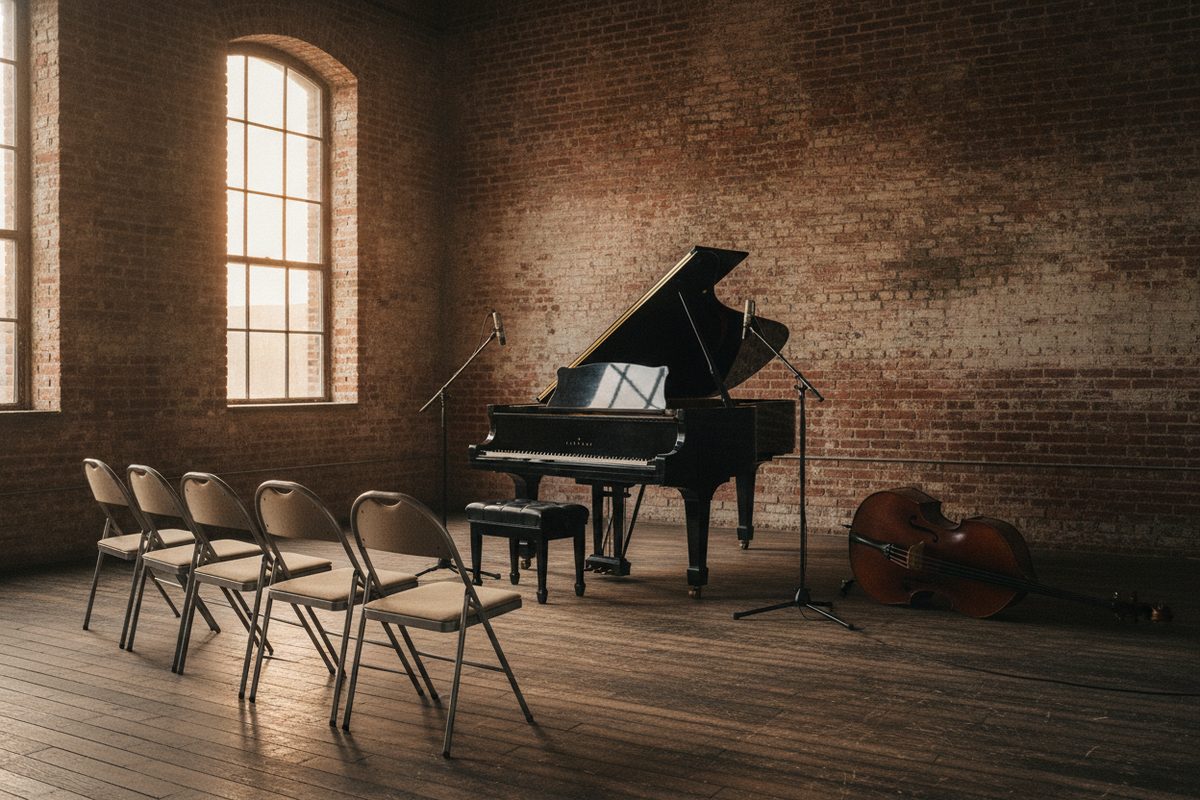
Many RANDOM ACOUSTICS records arrive without a map. A release page lists who played, where and for how long, and then leaves you alone with the sound. This guide is for listeners who want a way in. It keeps to what the label's own pages say: line-ups, track lists, recording lines and the three liner notes that survive in this archive.
What the term means, and what it leaves out
Free improvisation is music the players invent while they play it. There is no score to read and usually no agreed tune, key or metre; whatever shape a piece has, the musicians find it on the spot. The label's own texts do not use the phrase. Their description of the programme names "electronic music as well as contemporary chamber music, new jazz, and of course cross-overs in these areas" (the label). Steven A. Loewy, in his liner note to RA 026, writes of "what has become known as free music or avant garde jazz".
One name stands behind much of this music without appearing on any release documented here: Derek Bailey, the English guitarist who wrote Improvisation: Its Nature and Practice in Music. He runs through the biographies on this site. John Butcher took part in three of Bailey's Company Weeks and played in a trio with Bailey and Joelle Leandre. Martin Mayes came into contact with the Music Improvisation Company of Bailey and Evan Parker while he was at university. Marcio Mattos lists Derek Bailey's Company among the groups he has played in.
A word of caution before going further. Only one note in the archive states the method outright. Of RA 026, Loewy writes that "every piece on this recording is completely improvised, meaning that nothing is written." The other pages give names, numbers and places, and this guide does not claim more for them than they say.
No written score, but not "anything goes"
FOURinONE recorded Stelen live at LOFT in Cologne on 15 January 1999: Johannes Bauer on trombone, Luc Houtkamp on alto and tenor saxophone, Dieter Manderscheid on double bass and Martin Blume on drums. Where nothing is written, even the length of a piece is decided in the room, and the track list shows how far apart those decisions can fall. "Enchantment" runs 27:40. The title piece lasts 2:28.
Loewy is blunt about the risk. "Put four performers in a room and let them go," he writes, "and nine times out of ten the results will be chaos, sometimes interesting, but rarely precious." What makes the difference, in his account, is discipline: "the ability to subordinate to the group, to change focus on a moment's notice, and express individuality within a shifting field." The quartet also had a history before that evening. According to the note it first played together in Austria in late 1997, and Blume's biography lists FOURinONE among his own projects. Loewy calls him "the unofficial leader of this wholly collaborative effort".
For a first-time listener, this is the practical point. With no score, the structure of the music lives in the way four people respond to one another, so that response is the thing to follow.
What to listen for: dialogue, density, silence, timbre
Dialogue. In a duo you can hear who leads, who answers and when the roles swap. RA 002, Vicissetudes, is Frank Gratkowski on alto saxophone and Georg Graewe on piano, recorded live at LOFT on 21 March 1992. Its eleven pieces carry no titles, only the numbers VE 1 to VE 11, and none runs longer than 7:07. With nothing in the titles to steer you, the exchange between the two instruments is all there is to go on. Gratkowski's biography dates his duo with Graewe to 1992.
Density. A larger group can thicken and thin. RA 022, Lines, has five players: Jim Denley, Axel Doerner, Phil Wachsmann, Marcio Mattos and Martin Blume. Its twelve tracks swing between "bo-tree" at 12:21 and "tangents" at 1:02, with four pieces called "short cut" scattered in between. A sequence like that is a cue to listen for how much of the group is sounding at any moment.
Silence. Loewy's note on RA 025, Giancarlo Schiaffini's solo tuba record, says that "the emphasis is on silence and the single tone", and it closes with advice that holds for most of this catalogue: "This is a recording to be listened to closely; the results are in the details, in the nuances of time." Rests, held notes and the gaps between entries are part of the material, and they reward the same attention as the notes.
Timbre. Much of this music is about how an instrument sounds as much as which notes it plays, and the line-ups say so in their own words. Denley is credited with "flutes, alto sax, flax, voice" on RA 022, Mats Gustafsson with flageolet and fluteophone on RA 023, Melvyn Poore with "tubassoon" on RA 005. On RA 026 Loewy hears Houtkamp "chirp, sing, nudge, squeak, caress, and even disturb", while Bauer "slurps, trills, growls, and even speaks through brass". Read those verbs as a listening list.
Duo, trio, quartet: how line-up size changes the music
The size and make-up of a group change what can happen in it. Three records make the comparison easy, and the duo is RA 002, described above.
The trio on RA 011, Concert Moves, is John Russell on acoustic guitar, Phil Durrant on violin and John Butcher on tenor or soprano saxophone. There is no bass and no drums, so nobody in the group is cast as the rhythm section. Butcher's biography dates the trio with Durrant and Russell to 1984 and says it later grew, with Radu Malfatti and Paul Lovens, into News from the Shed. The record was made at Schloss Morsbroich in Leverkusen and at c.u.b.a. in Münster, and its seven titles share a taste for wordplay: "Playfair's axiom", "Nostalgesics", "Trompe-l'orielle".
The quartet on RA 001, Spellings, uses the instruments of a standard jazz quartet: Butcher on tenor and soprano saxophone, Graewe on piano, Hans Schneider on double bass and Blume on drums. The group is Frisque Concordance, which Butcher's biography lists among his work with Graewe, and the recording comes from a concert at the MUSEUM Bochum on 4 October 1992. Its five pieces, "spelling A" to "spelling E", each run longer than the one before, from 6:09 to 14:35. Familiar instruments help a new listener here, because you can hear what four players do with roles you already know from jazz.
For a quartet built another way, go back to RA 026: two horns over bass and drums, with no piano or guitar. For five players, RA 022.
A first listening path through the catalogue
- RA 026, Stelen. The one record whose note says plainly that nothing was written. Read the note while you listen.
- RA 002, Vicissetudes. Two players and eleven untitled pieces, none of them longer than about seven minutes.
- RA 011, Concert Moves. Guitar, violin and saxophone, without bass or drums.
- RA 001, Spellings. A jazz quartet's instruments, and five pieces that grow longer as the record goes on.
- RA 022, Lines. Five players, long pieces and very short ones. Most of it was recorded at Gateway Studio in Kingston upon Thames on 7 September 1996; "bo-tree" comes from a concert at the Museum Bochum on 27 October 1995.
- RA 023, Battuto. Eighteen short pieces recorded in Chicago, with a liner note by Georg Graewe that questions where improvising stops and composing starts. The article on composition and improvisation picks up that thread.
From there, the musician index lets you follow a player from one record to the next, and the recording chronology puts the catalogue in the order it was made. If the electronics on some of these records interest you, continue with electro-acoustic music on the label.
Further reading
Derek Bailey's Improvisation: Its Nature and Practice in Music is the obvious first book, and it was written by a working improviser. Closer to these records, the three liner notes reproduced in this archive are short and readable: Georg Graewe's note to RA 023, signed in Berkeley in February 2000, and Steven A. Loewy's notes to RA 025 and RA 026. The label page gives the label's own account of its programme.