The solo album and the unlikely instrument: tuba, horn, flute, drums
Solo tuba, horn, drums and keyboards, plus a flute and violin duo: how RANDOM ACOUSTICS recorded instruments rarely heard on their own.
Articles
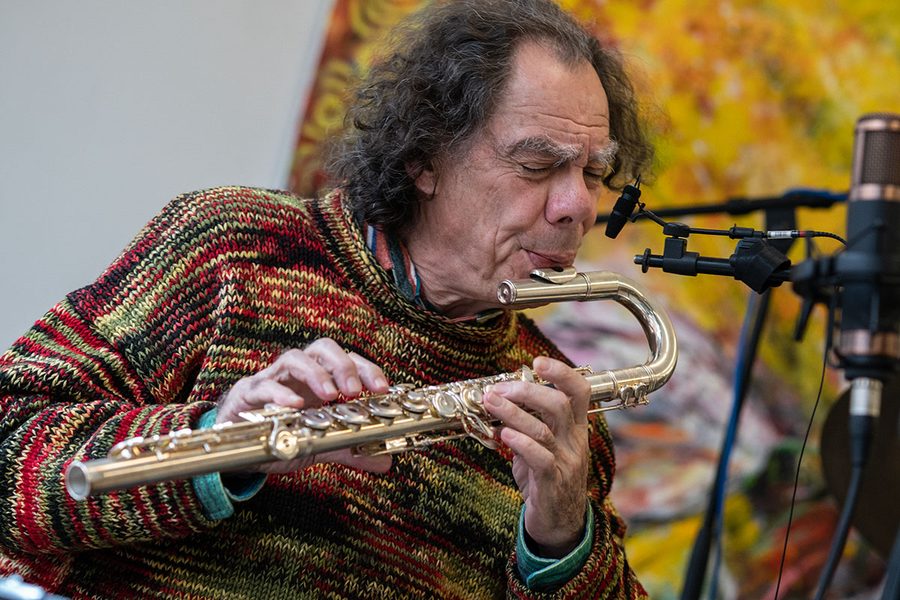
Records of one pianist or one guitarist are an old habit. A whole album for tuba, horn or drum kit is a rarer thing, and RANDOM ACOUSTICS made several. This article goes through them instrument by instrument: what the pages say about each player's technique, and what the track lists show about how a solo record is put together.
Why the solo recording is hard
Steven A. Loewy states the problem in his note to RA 025: "Solo albums are difficult vehicles in which to sustain the listener's interest." He is not being dismissive. His examples of the best are "the sterling contributions of Evan Parker, Anthony Braxton, and Peter Brötzmann", three saxophonists, and even those, he says, "can be tough to absorb in one sitting".
A solo player has to supply what a group shares out: contrast, pacing, a reason to keep listening. The players on this label met that demand in a few recurring ways, and the track lists show them. Some brought in a second voice, electronic or recorded. Some drew on the history of their instrument. Some built long works with several parts inside a single title.
Tuba: Schiaffini (RA 025) and Poore (RA 005)
According to Loewy, Tuba Libre was Giancarlo Schiaffini's "first solo CD and the first as a leader in which he plays exclusively tuba." His reputation rested on the trombone. His biography describes him as "Composer, trombonist, tubist", in that order, and notes that his treatise on contemporary trombone techniques is published by Ricordi. Loewy traces his tuba playing back to the 1960s, "off-and-on", and to the 1980s, when Schiaffini was a regular member of ensembles of Luigi Nono.
Schiaffini's own account of the instrument, as Loewy quotes it, is the best short guide to the record. "The sound is actually richer and in some ways easier to articulate than the trombone," he says, but "it is a less agile instrument and one in which it is more difficult to produce a variety of colors." Loewy's reply is to walk through the track list: "the mournful, lush sounds of the opening title tune", "the sort of rondo" of "El carrosel de Juana la Loca", "the mystical swaying" of "Mi mistico minimo Mi".
The Spanish titles have a story, which the note also tells. Schiaffini, a native of Rome, had visited Cuba in the mid-1990s, and he calls the titles a "dedication". "El vuelo irresistibile del moscardón", in his words, refers to "the theoretical impossibility of the bumble bee flying". Schiaffini recorded and mixed the album at his home studio in March 1997. Its electronics are discussed in the article on electro-acoustic music.
Melvyn Poore's RA 005, Groundwork, comes at the solo from the other side. The page title puts Poore's name alone, yet Lawrence Casserley is credited with live electronics, and only four of the nine pieces are marked "tuba solo": "STAND ALONE I", "II" and "III", and "STONEGROUND", which lasts 1:22. The three "STAND ALONE" pieces sit at tracks 2, 5 and 8, so the bare tuba keeps returning between pieces with tape, delay and electronics. Poore's second credit, "tubassoon", has a track of its own: "TUBASSOON" (1979), for "prepared tuba, four channel amplification".
Horn: Mayes, the natural horn and the "dopp-le horn" (RA 021)
Martin Mayes is credited with "horns", in the plural, on RA 021, Unique Horn 1997. His biography explains why. Born in Dumfries and resident in Turin when it was written, he began on the London experimental scene of the seventies, where he was a founder member of the London Musicians' Collective. Alongside improvisation and electronic music he is "interested in mediaeval and early classical music with particular emphasis on the traditional repertoire for the 'natural' (valveless) version of his difficult instrument".
The natural horn is the valveless horn of the eighteenth century. The player finds the notes with the lips and shades them with a hand in the bell, which is the "handhorn" technique the biography mentions. It calls Unique horn 1997 his first solo record and lists what goes into it: "Bach, handhorn, his self-invented 'dopp-le horn', echoing spaces and the use of words". Mayes was drawn early, the same text says, to "the music based purely on sound rather than pitch of Stockhausen and Cage", and Cage's Silence shaped his ideas.
The track list gives the shape. Two parts of "Requiem per Guelfo" open the record, the second at 17:01, the longest piece on it. "cantata #4" runs exactly 10:00. The titles reach for older forms and for literature: a requiem, a cantata, a suite, and "... sands with printless foot...", a phrase from Prospero's speech in Shakespeare's The Tempest. Track 5 reads only "suite from", as printed.
The recording line on the RA 021 page is the same line as on RA 001 ("Recorded live at MUSEUM Bochum on October 4, 1992"), and this archive does not use it; the about page explains why. The biography says only that the record's elements are "incorporated live in his solo concerts".
Flute and extended technique: Dick with Kimura (RA 018)
The archive holds no solo flute record. The nearest thing is RA 018, Irrefragable Dreams, which puts a flute virtuoso in the smallest company there is: Robert Dick on flute and Mari Kimura on violin. The page glosses its own title, "IRREFRAGABLE", as "unbreakable, undeniable".
Dick's biography, written in the promotional style of its time, describes the technique. His concerts typically use "flute, alto flute, bass flutes in C and F, and the giant, stand-up contrabass flute", and he has developed "thousands of multiple note combinations", the multiphonics that make one tube sound several pitches at once. He puts it in his own words: "I play the flute as a human-powered synthesizer, capable of continuous transformation of sound", and he stresses that this is "all totally acoustic without any electronic processing". That is what extended technique means here: ways of playing that reach past the instrument's conventional sound.
RA 018 credits him simply with "flute" and does not say which instruments of the family he uses. The ten titles lean towards old measures, instruments and shapes. Sixty minas made a talent in ancient weights ("60 Minas to a Talent"); an armillary sphere is an astronomer's model of rings; an Archimedes screw lifts water; an ogee is an S-shaped curve. Dick's biography also places him with Gerry Hemingway in two New York groups, Steel and Bamboo and Tambastics.
Percussion alone: Hemingway (RA 017)
For drums, the catalogue has RA 017, Electro-Acoustic Solo Works 1984-95. Hemingway's biography groups it with a second Random Acoustics release, "Acoustic Solo Works (83-94)", and with two earlier vinyl records, "Solo Works" on Auricle and "Tubworks" on Sound Aspects, as "recordings of his music for solo percussion". The solo here is a composer's project as much as a drummer's. The biography opens by saying he "has been composing and performing solo and ensemble music since 1974".
The track list shows how he holds a solo record together over time. There are five works, dated from 84 to 95, and the longest, "Aivilik Rays", is divided into four named parts: "Invisible Markers", "The art of Survival", "Migrations" and "Lost Frontier". The biography calls it "a concert length work". Tape gives a solo percussionist something to play against, and two of the five pieces are for tape alone.
Hemingway is the player who appears most often in this archive. Besides the solo record he plays drums on RA 003, RA 007, RA 012 and RA 020; the musician index lists all five.
Keyboards and electronics alone: Lehn (RA 027)
The last number in the catalogue, RA 027, Feldstaerken, is a solo by Thomas Lehn on keyboards, and its only production credit is the player himself: "All tracks were recorded and mastered by Thomas Lehn." Schiaffini's Tuba Libre carries a similar credit, recorded and mixed at his own home studio. On both records the solo extends past the playing into the production.
Lehn's eleven tracks run from 1:56 to 14:55, and the titles number them as fields ("feldstärke") and "tableaux". That makes a solo record out of many separate pieces, the opposite approach to Mayes's two-part requiem and Hemingway's four-part "Aivilik Rays". The label released both kinds. Where the pages say when these solo records were made, the recording chronology places them among the group sessions.
Records discussed
- RA 003 · Chamber Works 1990-92, Georg Graewe
- RA 005 · Groundwork, Melvyn Poore
- RA 007 · Flex 27, Graewe, Reijseger, Hemingway
- RA 012 · Slamadam, Gerry Hemingway Quintet
- RA 017 · Electro-Acoustic Solo Works 1984-95, Gerry Hemingway
- RA 018 · Irrefragable Dreams, Robert Dick and Mari Kimura
- RA 020 · The Flume Factor, Frank Gratkowski Trio
- RA 021 · Unique Horn 1997, Martin Mayes
- RA 025 · Tuba Libre, Giancarlo Schiaffini
- RA 027 · Feldstaerken, Thomas Lehn