Electro-acoustic music: live electronics, tape and acoustic instruments
Tape, live processing and electronic instruments beside acoustic ones: the electro-acoustic side of RANDOM ACOUSTICS, from Earl Howard to Thomas Lehn.
Articles
Electronic music comes first in the label's description of its own programme: "electronic music as well as contemporary chamber music, new jazz, and of course cross-overs in these areas." On the records, though, electronics rarely work alone. They sit next to a tuba, a saxophone, a drum kit or a violin. The most useful thing the archived pages offer is precision about how, because several track lists name the set-up piece by piece, in phrases such as "tuba, stereo delay system" and "for two simultaneous processed tapes". This article follows those phrases.
Three ways acoustic and electronic sound meet
Electro-acoustic is a loose word. In practice it covers three arrangements, and all of them turn up on this label.
- Tape. Sounds fixed in advance and played back. A live player may perform against them, or the tape may stand alone as the piece.
- Processing. The sound of an acoustic instrument picked up and transformed while it is being played, by delay, amplification or a computer.
- Electronic instruments played live. Synthesisers, samplers or custom set-ups, handled by a performer in real time beside acoustic players.
The categories blur in practice, and a credit such as "live electronics" does not say which of them is meant. They are still a good way to sort what you hear. Steven A. Loewy, in his note to RA 025, gives a short lineage for pairing electronics with an acoustic instrument: Vladimir Ussachevsky and Otto Luening, "as far back as the 1950s", and "the more recent experiments of trombonist George Lewis".
Live electronics in the catalogue: Earl Howard and Lawrence Casserley
Earl Howard is credited with "live electronics" on RA 004, Pele's Tears, recorded at LOFT in Cologne on 13 October 1993 "during an evening of RANDOM ACOUSTICS". The other three players are acoustic: Frank Gratkowski (printed "Frank Gratowski" on this page) on alto saxophone, Melvyn Poore on tuba and Hans Schneider on double bass. The track list mixes formats. "Bottle, for live electronics (1992)" runs 13:06 and names only the electronics. "Hell" and "Pele's Tears", both dated 1986, and two pieces called simply "Quartet One" and "Quartet Two" make up the rest. The page does not give a line-up per track.
Howard turns up in two biographies on this site. Gerry Hemingway's says he "performs regularly as a duo with live electronics and saxophone virtuoso, Earl Howard", and Martin Blume lists Howard among the musicians he has worked with.
RA 005, Groundwork, is the most explicit record in the catalogue about its technology. Poore plays tuba and "tubassoon", Lawrence Casserley is credited with live electronics, and Ansgar Ballhorn recorded it at LOFT in 1994. Each of the nine titles states its own set-up:
- "ONE, TWO, THREE" (1986): tuba, stereo delay system
- "STAND ALONE I" (1994), "STONEGROUND" (1991), "STAND ALONE II" (1991), "STAND ALONE III" (1994): tuba solo
- "PLAYBACK" (1978): tuba, tape records
- "TUBASSOON" (1979): prepared tuba, four channel amplification
- "AND FINALLY" (1993): tuba, live electronics
- "STUDY IN MOVING SOUNDS" (1994): tape music
Read down the list and the record becomes a survey of the three arrangements above. There is a tuba against tape, a tuba through a delay system, a prepared tuba spread over four channels, a tuba with a live electronic partner and the tuba alone, and at the end a piece of tape music with no tuba credited at all. "AND FINALLY", the piece with live electronics, is the longest track at 11:07.
Another duo is harder to read. RA 010, Snake Eyes by Pair a' Dice, credits Joker Nies and Jeffrey Morgan with alto saxophone and "midiotics", a coinage with MIDI in it that the page does not explain. Nies also recorded and mixed the album at the BEX-Studio in Cologne over three sessions between December 1993 and September 1994, and one of the ten capitalised titles, "BEX DRY RAM", borrows the studio's name.
Electronics also appear as a second instrument in the hands of string players. On RA 022, Lines, Phil Wachsmann is credited with "violin, viola, electronics" and Marcio Mattos with "double bass, cello, electronics". Mattos's biography gives the background. After moving from guitar to double bass and cello, he entered the Villa-Lobos institute, "where he became involved in improvisation and electronic music", and he later played in the West Square Electronic Music Ensemble.
Percussion and tape: Hemingway (RA 017)
RA 017, Electro-Acoustic Solo Works 1984-95, collects pieces by Gerry Hemingway for percussion and electronics. The subtitles are the set-ups:
- "Waterways" (84), for tape and percussion
- "Aivilik Rays" (90), for tape, acoustic and processed percussion, in four parts: "Invisible Markers", "The art of Survival", "Migrations", "Lost Frontier"
- "Totem" (85), for tape
- "Chatterlings" (95), for midi triggered sampler and percussion
- "Polar" (90), for two simultaneous processed tapes
Two of the five pieces credit no live percussion at all. "Totem" is for tape and "Polar" for two processed tapes, on a record by a drummer. The other three use the three arrangements in turn: percussion with tape, percussion that is itself processed, and percussion beside a MIDI-triggered sampler.
Hemingway's biography supplies the background. "Aivilik Rays" and "Polar" were among four commissions he received from the Parabola Arts Foundation with funding from N.Y.S.C.A. The biography calls "Aivilik Rays" a concert-length work for tape and percussion and "Polar" "a quadrophonic electronic work"; the CD describes "Polar" as for two simultaneous processed tapes, and neither text reconciles the two descriptions. "Waterways" also exists in a multimedia form, "for multiple slide projectors, tape and percussion". On the CD the slide projectors are gone and the subtitle reads "for tape and percussion". The same biography mentions a companion release, "Acoustic Solo Works (83-94)" on Random Acoustics, which is not among the pages preserved here.
The synthesiser as an instrument: Thomas Lehn (RA 027)
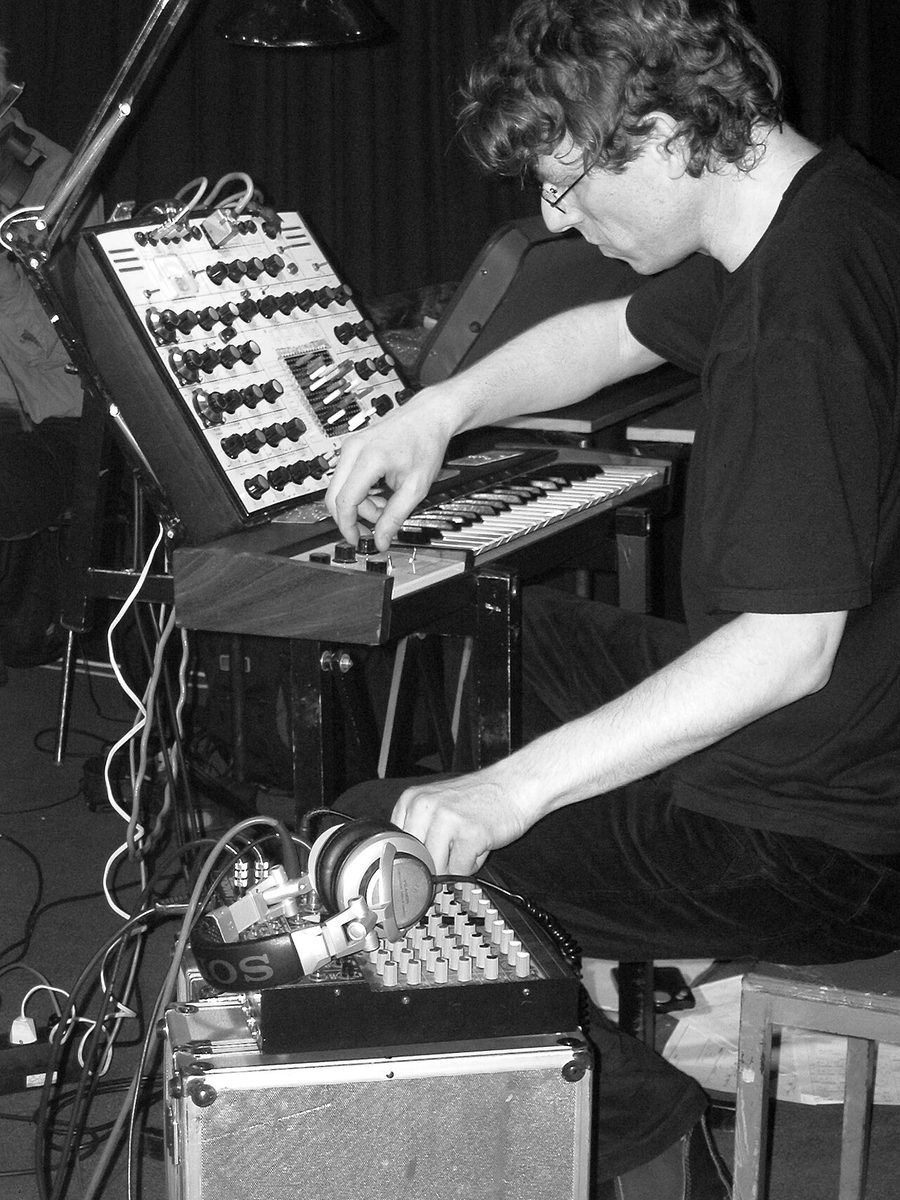
RA 027, Feldstaerken, has a single player: Thomas Lehn, credited with "Keyboards". The page adds one line about production: "All tracks were recorded and mastered by Thomas Lehn." Other pages on this site are more specific about what Lehn plays. John Butcher's biography mentions a trio "with EX guitarist Andy Moor and synthesist Thomas Lehn". Hemingway's names their duo "Tom & Gerry" and describes Lehn as one "who performs live analog electronics".
Feldstärke is the physicist's word for field strength. The eleven tracks are numbered fields and tableaux, and the numbers come out of order. The record opens with "feldstärke 8" at 1:56, reaches "feldstärke 1" fourth, and places three untitled "feldstärke" pieces among the numbered ones, with "tableaux 1" to "3" spread between them. The longest piece, "feldstärke 2", runs 14:55.
For a listener new to electronic improvisation, the solo setting has an advantage. There is no acoustic instrument on the record to measure the sounds against, so they have to be heard on their own terms.
Electronics as a partner to a solo instrument: Schiaffini (RA 025)
Giancarlo Schiaffini recorded and mixed RA 025, Tuba Libre, at his home studio in March 1997. It is a solo tuba album with electronics, and Loewy's note is precise about their role. Schiaffini, he writes, uses "the electronics as a separate, additional instrument", which Loewy calls "a partner, even a shadow, perhaps an alter ego". He adds that this has "rarely, if ever, been heard with the tuba".
The note points to particular tracks, among them "the layered tubas on 'Voz Refracta'". Schiaffini's biography fills in the training behind the record: a physics degree from the University of Rome, study at Darmstadt in 1970 with Stockhausen, Ligeti and Globokar, and IRCAM among the places where he has performed. The tuba itself, and the old problem of the solo record, are the subject of the companion article on solo albums.
Where to start listening
- RA 005, Groundwork. Every title states its set-up, so you can check what you hear against the page, piece by piece.
- RA 017, Electro-Acoustic Solo Works 1984-95. The same idea from a percussionist, including two pieces for tape alone.
- RA 004, Pele's Tears. Live electronics in a quartet, recorded at a label evening at LOFT.
- RA 025, Tuba Libre. Electronics as a partner to one acoustic instrument.
- RA 027, Feldstaerken. Keyboards and electronics with no acoustic instrument at all.
- RA 022, Lines. Electronics folded into a five-piece group.
The musician index shows where these players appear elsewhere in the catalogue, and the recording chronology places the sessions in order. For the listening habits that help with all of this music, see how to listen to free improvisation.