Random incidence: the diffuse field and the reverberation room
What random incidence means: the diffuse sound field, the random-incidence absorption coefficient and the ISO 354 reverberation room as reference.
Acoustics
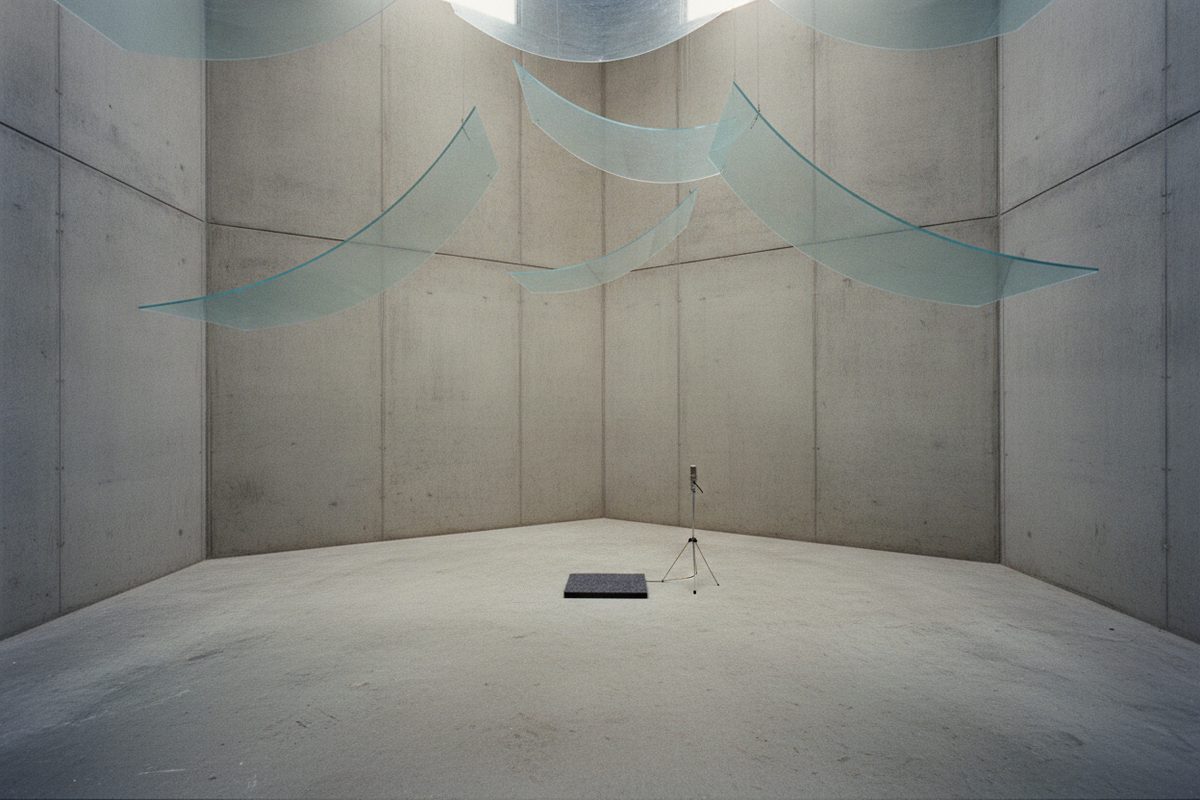
Sound in a room reaches a listener first along the straight line from the source, then again and again from the floor, walls and ceiling. After a few dozen reflections the paths are too many to follow one by one. Statistical room acoustics then stops tracing waves and describes the sound, as energy arriving from every direction with no fixed phase relation between the parts. "Random incidence" is the name for the assumption that every direction of arrival is equally likely. It sits behind the reverberation formulas in the textbooks and behind most absorption data printed for building materials.
The phrase is also close to the name of the label this archive documents, RANDOM ACOUSTICS. The introduction to this section explains how the two connect.
The diffuse field
A diffuse sound field is an idealisation with three properties. The sound energy density is the same everywhere in the room. At any point, sound arrives from all directions with equal probability and equal intensity. And the waves arriving from different directions have random phases, so they add as energies rather than as pressures.
No real room is perfectly diffuse. The idea is useful because many rooms come close to it over part of the frequency range, and because it turns an intractable wave problem into simple bookkeeping. If energy is spread evenly and arrives from everywhere, the rate at which it is lost depends only on the total amount of absorbing surface. Where that surface sits drops out of the calculation.
Two results follow directly. The mean free path, the average distance sound travels between two reflections, is 4V/S, where V is the room volume and S its total surface area. And the reverberation time, the time for the sound level to fall by 60 dB once the source stops, is given by Sabine's formula:
T = 0.161 · V / A
with T in seconds, V in cubic metres and A the equivalent absorption area in square metres. A is the sum of each surface area multiplied by its absorption coefficient: A = S1·α1 + S2·α2 + … Wallace Clement Sabine found the relation by experiment at Harvard around 1900, and later derivations from diffuse-field theory reproduce it. The constant comes from the speed of sound: 0.161 is 24 · ln 10 divided by c, with c about 343 m/s at room temperature. Eyring's variant, T = 0.161 · V / (−S · ln(1 − ᾱ)), where ᾱ is the mean absorption coefficient, gives shorter and more realistic values in strongly absorbing rooms. Both assume a diffuse field.
When statistics take over: the Schroeder frequency
At low frequencies a room behaves like a resonator with a countable set of modes. Each mode has its own frequency and its own pattern of loud and quiet places, so the sound at a point depends strongly on where the point is. As frequency rises, the modes crowd together and overlap until many of them are excited at once at any frequency. Manfred Schroeder gave a widely used estimate of the crossover:
fS ≈ 2000 · √(T / V)
with T in seconds and V in cubic metres. Above fS the statistical description works; below it, the modes have to be treated individually. For a room of 200 m³ with a reverberation time of 5 s, fS ≈ 2000 · √0.025 ≈ 320 Hz. For a small room of 60 m³ with 0.5 s it is about 180 Hz. This is why diffuse-field results are least reliable in the lowest bands, a point the article on measuring reverberation time returns to.
The random-incidence absorption coefficient
An absorption coefficient α is the fraction of incident sound energy that a surface does not reflect: 0 for a perfect reflector, 1 for a perfect absorber. For most materials it depends on frequency and on the angle at which sound arrives. A porous layer struck head-on, at normal incidence, absorbs differently from the same layer struck at a shallow angle.
The random-incidence absorption coefficient is the average over all angles, weighted as the angles occur in a diffuse field. Two factors set the weighting: a surface intercepts a beam in proportion to the cosine of the angle from the normal, and there are more directions near grazing than near the normal, in proportion to the sine of that angle. Together they give the classic average, sometimes called Paris's formula:
αrandom = ∫ α(θ) · sin 2θ dθ, integrated over θ from 0° to 90°
Where α(θ) is known, for instance from a measured or calculated surface impedance, the average can be computed. The result is often called the statistical absorption coefficient. Absorption data for room design, though, come from a measurement designed to approximate random incidence physically.
The reverberation room and ISO 354
A reverberation room is the counterpart of an anechoic chamber. Its surfaces are hard, heavy and smooth, so very little sound is absorbed and the reverberation time is long, typically several seconds. The walls are often non-parallel, and reflecting panels hung in the air act as diffusers, scattering sound in many directions so that the field comes as close to diffuse as the room allows.
ISO 354, Acoustics – Measurement of sound absorption in a reverberation room, sets out the procedure. It asks for a room volume of at least 150 m³, and about 200 m³ for newly built rooms. The main steps are:
- Measure the reverberation time of the empty room, T1, in one-third-octave bands from 100 Hz to 5000 Hz, with several source and microphone positions.
- Install the test specimen. For a flat absorber the standard asks for an area of roughly 10 to 12 m², close to square, in a defined mounting: directly on the floor, for instance, or with a specified air gap behind it.
- Measure the reverberation time again, T2.
- Calculate the equivalent absorption area the specimen adds, from the change in reverberation time, corrected for air absorption.
The calculation is Sabine's formula applied to the difference:
AT = 55.3 · V · (1 / (c2 · T2) − 1 / (c1 · T1)) − 4V · (m2 − m1)
Here c is the speed of sound at the temperature of each measurement and m the power attenuation coefficient of air, calculated from ISO 9613-1; the air term matters mainly at high frequencies. Dividing AT by the specimen area S gives the Sabine absorption coefficient, αs = AT / S. Objects without a clear area, such as chairs or people, are reported as absorption area per object.
The decays can be measured with interrupted noise or from integrated impulse responses, both explained in the article on reverberation time. The diffusers matter to the result. An annex of the standard describes how to check that enough of them are installed: an absorbing specimen is measured with an increasing number of diffusers until its measured absorption stops rising.
Why the reverberation room is the reference
Three reasons make this test the reference for absorption data.
First, it matches the use. In most rooms, sound reaches a ceiling or a wall panel from many directions, and the reverberation formulas designers use expect a random-incidence coefficient.
Second, it makes results comparable, since every laboratory works to the same specimen size, frequency bands and calculation. Inter-laboratory comparisons have nonetheless shown a noticeable spread for the same material, largest at low frequencies, so small differences between results from different laboratories deserve little weight.
Third, it can test what a small sample cannot: large panels with air gaps behind them, perforated or slotted panels, suspended baffles, seating, curtains and other objects whose behaviour depends on size and mounting.
The single numbers on data sheets, the practical coefficient αp, the weighted coefficient αw and the absorption classes of ISO 11654, are all derived from αs. The NRC and SAA of the American standard ASTM C423 come from the same kind of test. The article on normal and random incidence explains how these numbers are formed, why a laboratory can report an αs above 1, and how the result differs from an impedance-tube measurement.
Where the assumption fails
Ordinary rooms break the diffuse model in familiar ways. Take a room 6 m long, 5 m wide and 3 m high: V = 90 m³ and S = 126 m². Suppose the only treatment is an absorbing ceiling with α = 0.70 at 1 kHz, and every other surface has α = 0.05. Then A = 30 · 0.70 + 96 · 0.05 = 21 + 4.8 = 25.8 m², and Sabine's formula gives T = 0.161 · 90 / 25.8 ≈ 0.56 s.
In a real room of this kind the measured reverberation time often comes out longer than predicted, because all the absorption sits on one surface. Sound travelling horizontally between the bare walls rarely meets the ceiling, so it decays slowly while the vertical paths die away quickly. The decay curve is then no longer one straight line, and the reverberation time depends on which part of the curve is evaluated. Furniture, shelves and irregular surfaces help by scattering that horizontal sound towards the absorbing ceiling. Large flat rooms with absorbing ceilings, such as open-plan offices, fit the model so poorly that they have their own metrics, discussed under speech in open-plan rooms.
Rooms for music sit in between. A hall or club room with an audience and irregular walls can be reasonably diffuse above a few hundred hertz and strongly modal below, so the bass changes from one spot to the next while the upper range sounds much the same everywhere. The article on recording rooms looks at what this means for a microphone.
Three idealised sound fields
| Field | What it assumes | Where it is approximated |
|---|---|---|
| Free field | Sound travels outward with no reflections; from a point source the level falls by 6 dB per doubling of distance | Anechoic chamber; open air far from surfaces |
| Diffuse field | Uniform energy density, sound arriving from all directions with equal probability and random phase | Reverberation room, above its Schroeder frequency |
| Pressure field | Pressure equal in magnitude and phase throughout a small enclosed volume | Couplers and cavities much smaller than the wavelength |
Measurement microphones are designed for one of these fields: a free-field microphone is flat for sound from the front, a pressure microphone in a closed coupler, and a random-incidence microphone for sound from all directions at once.
Key terms
- Diffuse field: an idealised sound field with uniform energy density and sound arriving equally from all directions with random phase.
- Random incidence: the condition in which every direction of arrival at a surface is equally probable, as in a diffuse field.
- Sabine absorption coefficient (αs): absorption measured in a reverberation room to ISO 354, the added equivalent absorption area divided by the specimen area.
- Equivalent absorption area (A): the area of a perfect absorber that would absorb as much sound as the surface or object in question, in m².
- Schroeder frequency: the frequency above which room modes overlap enough for statistical room acoustics to apply, roughly 2000 · √(T / V).
- Reverberation room: a hard-surfaced, diffuse test room with a long reverberation time, used to measure absorption and sound power.