Speech in shared rooms: intelligibility, privacy and open-plan metrics
Speech in shared rooms: STI basics, privacy versus intelligibility, ISO 3382-3 metrics (D2,S, Lp,A,S,4m, rD), masking sound, absorption and screens.
Acoustics
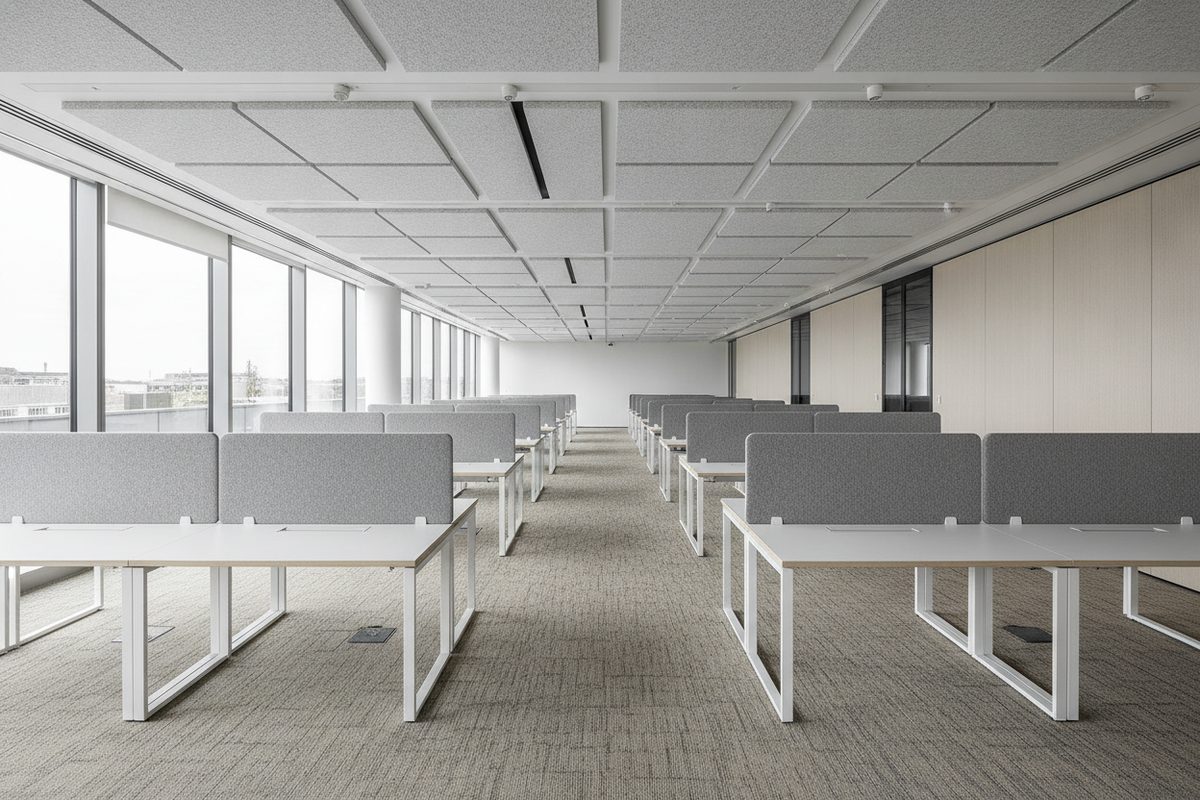
In a lecture hall the aim is for every word to reach every seat. In an open-plan office, a library or a shared workshop the aim is split. Speech should be easy to understand within a group working together and hard to understand a few desks away, where it turns into distraction. The same physics governs both cases, and the same measures describe them; what changes is which end of the scale is wanted.
The Speech Transmission Index
The Speech Transmission Index, STI, defined in IEC 60268-16, rates how well the path between a talker and a listener preserves speech. It runs from 0, nothing intelligible, to 1, perfect transmission.
Its starting point is that the intensity of speech rises and falls slowly as syllables come and go, a few times per second. Reverberation fills the gaps between syllables, background noise lifts the quiet parts, and both flatten that fluctuation by the time it reaches the listener. STI measures how much. The method analyses seven octave bands from 125 Hz to 8 kHz and fourteen modulation frequencies from 0.63 Hz to 12.5 Hz, converts each loss of modulation into an apparent signal-to-noise ratio, and combines the results with weightings for the bands.
STI can be measured directly with a modulated test signal, or calculated from an impulse response together with measured speech and noise levels. A simplified method for public address systems, STIPA, uses a single test signal carrying a reduced set of modulation frequencies.
The traditional qualification of STI values is:
- 0.00 to 0.30: bad
- 0.30 to 0.45: poor
- 0.45 to 0.60: fair
- 0.60 to 0.75: good
- 0.75 to 1.00: excellent
Later editions of IEC 60268-16 add finer categories for sound systems, but these five bands remain in wide use. A related, simpler measure is definition, D50, the share of sound energy arriving in the first 50 ms, explained in the article on recording rooms.
Privacy and intelligibility
In an open-plan room, a high STI at the next desk is a problem. Laboratory research on the irrelevant speech effect has shown repeatedly that speech one can understand disturbs tasks such as reading, writing and memorising more than speech one cannot. Between workstations, then, the goal is speech privacy: a low STI from one desk to the next. Within a team or a meeting area a high STI is still welcome.
Two physical quantities set the STI in such rooms. One is the speech level at the listener, which falls with distance at a rate the room determines. The other is the background noise, which masks speech. In a room with very little background noise even distant speech stays intelligible, which is why a very quiet open-plan office can be a poor one.
Why reverberation time is not enough
Reverberation time, the usual measure of room acoustics, assumes a diffuse field (see random incidence). An open-plan office is close to the opposite: large, low and flat, often with an absorbing ceiling over a hard or carpeted floor. Sound does not spread evenly through it; it fades with distance. Two offices can share a reverberation time and differ greatly in privacy.
A more useful measure is how fast the speech level falls each time the distance doubles. In a free field, from a point source, the rate is 6 dB per doubling. In a perfectly diffuse field, beyond the critical distance, it approaches 0 dB, because the reverberant level is the same everywhere. A well-treated open-plan office moves towards free-field behaviour, while a poor one keeps speech loud far from the talker.
ISO 3382-3: measuring an open-plan office
ISO 3382-3, first published in 2012 and since revised, describes a measurement along a line of workstations. An omnidirectional loudspeaker stands at one workstation, and the levels it produces are converted to those of a talker speaking with normal effort, using a standard speech spectrum. Speech level, background noise and STI are then determined at workstations at increasing distances along the line, and single-number quantities are derived from them.
| Quantity | Meaning | Better when |
|---|---|---|
| D2,S | Spatial decay rate of the A-weighted speech level per doubling of distance, in dB | Higher |
| Lp,A,S,4m | A-weighted speech level at 4 m from the source, in dB | Lower |
| rD | Distraction distance: the distance at which STI falls below 0.50 | Shorter |
| rP | Privacy distance: the distance at which STI falls below 0.20 | Shorter |
| Lp,A,B | A-weighted background noise level at the workstations | Steady and unobtrusive |
D2,S and Lp,A,S,4m describe the room itself: its absorption, screens and layout. rD and rP also depend on the background noise, so they change when ventilation or masking sound changes. An informative annex of the 2012 edition gives indicative values. Good conditions are marked by a decay of at least 7 dB per doubling, a speech level at 4 m of no more than 48 dB and a distraction distance of no more than 5 m; poor conditions by less than 5 dB, more than 50 dB and more than 10 m. Check the edition in force before treating these figures as targets. National guidelines and the later open-office standard ISO 22955 set requirements of their own.
The measurement methods behind these figures, impulse responses, band filtering and the handling of background noise, are the same as those described in measuring reverberation time.
Absorb, block, cover
Open-plan acoustic design is often summarised in three verbs.
Absorb. The ceiling is the most important surface. Wherever a screen stands between two desks, the main remaining path from one to the other runs via the ceiling, and a highly absorbing ceiling weakens it. Absorption on walls near workstations, on screen surfaces and in furniture helps further, and a soft floor covering reduces footsteps and chair noise. More absorption raises the spatial decay rate and lowers the speech level at a distance. The article on normal and random incidence explains how to read the absorption data of ceiling products.
Block. Screens between desks interrupt the direct path. Their effect depends on their height relative to seated heads, on how close they stand to talker and listener, and on the ceiling above them: under a hard ceiling a screen achieves little, because sound passes over it by reflection. Shelving, storage and the orientation of desks can do the same job. Distance is a tool too. Grouping people who need to talk to each other keeps their speech away from those who need quiet.
Cover. Masking sound is a steady, broadband sound added through loudspeakers, usually with a spectrum that falls towards high frequencies so that it sounds soft rather than hissy. It raises the background level, lowers the STI at a distance and so shortens the distraction distance. It is a delicate tool. Too little has no effect. Too much becomes a noise problem of its own and can make people raise their voices, the Lombard effect, which gives back part of the gain. Masking is set and adjusted on site, and it works best once absorption and blocking have done their part.
Rooms for what open plan cannot do
None of these measures removes the need for enclosed rooms. A phone call, a long discussion or work that needs full concentration is better served by a separate room or a small enclosure. What such enclosures achieve, and how their speech level reduction DS,A is measured under ISO 23351-1, is the subject of enclosures and insulation.
Measuring in practice
A few points keep open-plan measurements meaningful.
- Measure in the furnished room, with screens and storage in place, since they are part of the acoustic design.
- Choose measurement lines that follow real working positions, with source and microphone at the heights of seated talkers and listeners.
- Record the background noise with ventilation in its normal state and any masking system at its normal setting, and say so in the report.
- Report both D2,S and rD. A room can improve in one and stay the same in the other, for example when masking is added without any change to the room.
- Treat a single line as a sample. Large rooms with different zones need several lines, and the results describe those lines.
The same thinking applies to any shared space where some people talk while others listen or work: a reading room, a shared studio, a rehearsal building with an open common area. The section index lists all six articles.
Key terms
- Speech Transmission Index (STI): a 0 to 1 rating, defined in IEC 60268-16, of how well a transmission path preserves the modulations of speech.
- Speech privacy: the condition in which speech from a neighbouring position is audible but hard to understand.
- D2,S: the rate, in dB per doubling of distance, at which the A-weighted speech level falls along a line of workstations.
- Lp,A,S,4m: the A-weighted speech level at 4 m from the source, normalised to normal vocal effort.
- Distraction distance (rD): the distance from a talker at which STI falls below 0.50.
- Masking sound: steady, broadband background sound added to reduce the intelligibility of distant speech.